

ASIC & Solutions
Custom ASICs on MIPI PHY and protocol layers, and frame-grabber solutions for mobile and automotive camera module test.
Not every need fits a catalog part. Some customers need a MIPI interface inside a device of their own; others need the whole path from a camera module in a test socket to the frames on a server, ready to run. SUGARS AI does both, and both start from the same place: PHY blocks that already ship in production ICs, and protocol-layer blocks designed and verified in-house — all of them the company's own.
Custom ASIC
SUGARS AI designs application-specific ICs around its own MIPI blocks: C-PHY and D-PHY at the physical layer; CSI-2 at the protocol layer, including Multi-Pixel Compression (MPC); and DSI-2, including the VESA Display Stream Compression (DSC) and VDC-M codecs. The same team also takes on general SoC ASICs where a customer's design calls for a mixed-signal front end and a digital core in one part.
An ASIC engagement that begins from a specification spends its first months proving the interface. One that begins from a PHY already shipping in production ICs spends them on the customer's part instead. The PHY here has been characterized after the cable, across shifts, in test equipment, and the protocol layers above it were designed and verified by the same team — so the risk a customer inherits is the risk of their own logic, not of the interface underneath it.
The engagement runs from specification and architecture through design, tape-out, engineering samples, and production support. Because the interface blocks are the company's own, questions about them are answered by the engineers who designed them.
Camera Frame Grabber Solution
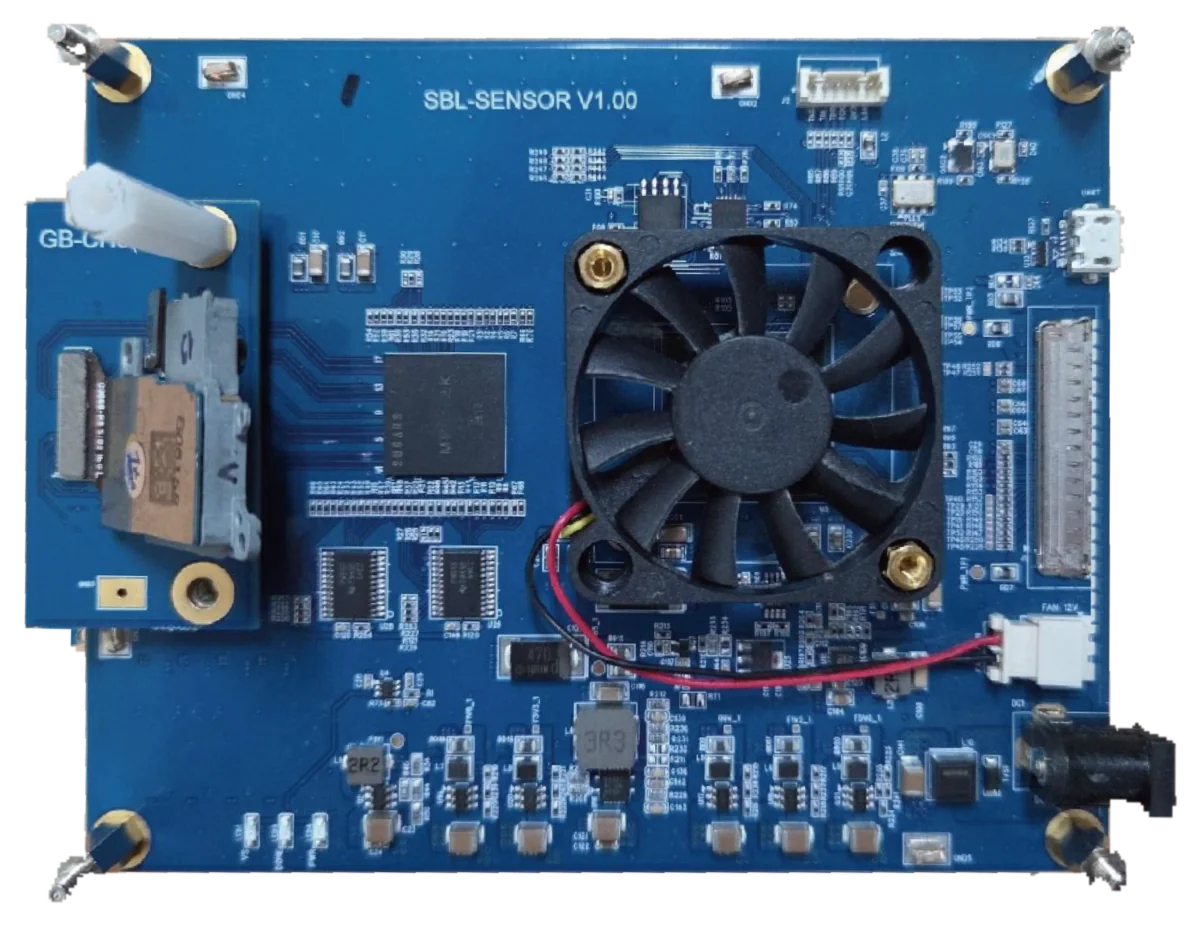
For mobile and automotive camera module test, SUGARS AI delivers the complete path from the module to the server — three boards and the software that ties them together. The module under test sits on a jig board. A recovery board takes the module's MIPI output, recovers the CSI-2 RAW stream, and sends it over an optical link. A PCIe card in the server receives that link and delivers the frames to the host, with the driver provided.
Three deliverables make up the path. A jig board holds the camera module under test and is matched to the module and the test socket. A CSI-2 RAW recovery board, built around Bridge IC, receives the module's MIPI C-PHY or D-PHY output, recovers the CSI-2 RAW stream, and sends it over an optical link. A PCIe capture card receives that optical stream in a server slot and delivers the frames to the host, with the driver software supplied.
An optical link between the test head and the server carries the full stream without electrical coupling to the line, so the analysis server can be placed away from the test floor and one server can serve more than one head. The signal that arrives is the sensor's own RAW output; nothing in the path compresses or reconstructs it.


| Deliverable | What it does | Supplied as |
|---|---|---|
| Jig board | Holds the camera module under test; matched to the module and the test socket | Designed, built, and delivered |
| CSI-2 RAW recovery board | Receives MIPI C-PHY / D-PHY from the module, recovers the CSI-2 RAW stream, outputs over an optical link; built around Bridge IC | Board |
| PCIe capture card | Receives the optical stream in a server PCIe slot and delivers frames to the host | Card with driver software |
contact sugars@sugars.kr